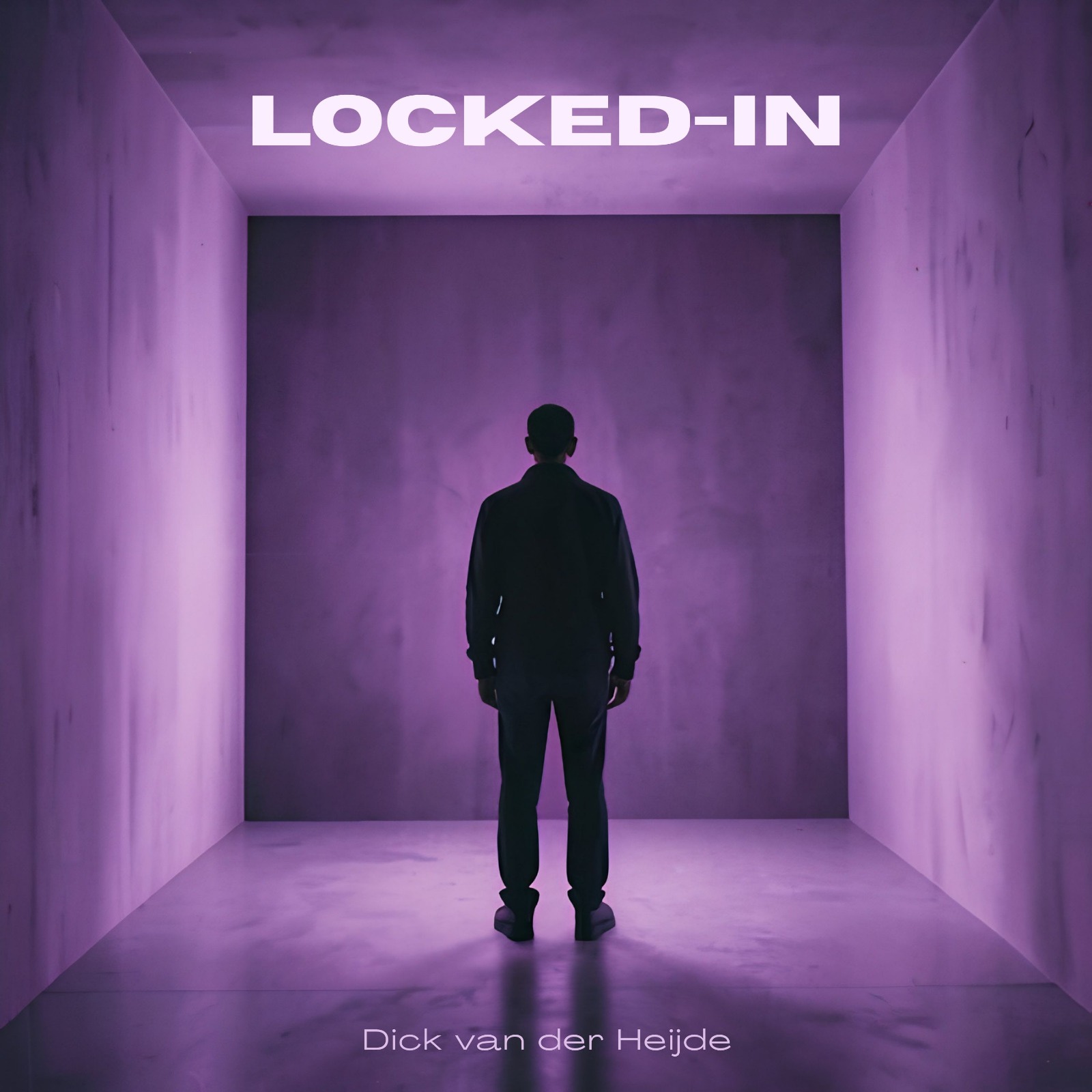
Full-length, Eigen Beheer Records (2026)
There are albums that arrive as music first, and others that inevitably arrive as testimony. “Locked-In” exists in the fragile space between the two, but what ultimately defines it is not its sound, nor even its structure—it is the philosophical weight of what it represents in an era increasingly shaped by artificial creation.
Dick van der Heijde’s debut is inseparable from his condition. After a brainstem stroke at the age of 28, he was left completely paralysed and unable to speak, a state known as Locked-In Syndrome. Communication became possible only through eye movements, letter by letter, in an extremely slow and demanding process that nonetheless allowed him to continue writing, reflecting, and engaging with music as a critic and listener for decades.
Before the stroke, composing progressive rock had been his central creative drive. The accident did not erase that identity, but it suspended it indefinitely—reducing music to something observed rather than produced. That suspension lasted for more than thirty years.
The turning point came with the emergence of AI-assisted creative tools. Far from functioning as a replacement for artistic intent, this technology reopened a channel that had been closed for decades. Van der Heijde describes the experience as a kind of “volcanic eruption” of creativity: a sudden, overwhelming return of ideas that had remained locked inside for years. In a short span of time, he composed around forty songs, ultimately shaping them into “Locked-In”, a concept album directly rooted in his lived experience.
Yet it would be reductive to interpret the record as a technological curiosity or a narrative of overcoming adversity. At its core, the album functions as a statement about agency, consciousness, and what remains fundamentally human when physical expression is almost entirely removed. AI does not replace the artist here—it restores a bridge between imagination and articulation, allowing intention to re-enter form.
This philosophical dimension is reflected in the music itself. “Locked-In” is built as a progressive rock work, but it avoids both excess and spectacle. Instead, it leans toward controlled dynamics, cinematic restraint, and a strong sense of narrative fragmentation. Rather than presenting a continuous autobiographical line, the album moves through emotional states, internal reflections, and symbolic moments that suggest perception rather than literal storytelling.
The opening of the record establishes this tone with immediate clarity. “Blue Door” functions as an entry point into a confined but carefully shaped sonic environment, where space and silence are as important as sound. “Still Here (Ballad Version)” distills the emotional core of the project into a minimal melodic statement, carrying a sense of presence that resonates beyond its simplicity.
One of the most conceptually significant moments arrives with “Blink Once For Yes”, a title that directly references the only form of communication available after Van der Heijde’s stroke. However, rather than literal illustration, the track translates this idea into musical tension: repetition, hesitation, and restrained harmonic movement create the impression of meaning forming under constraint.
As the album unfolds, tracks such as “Learning Curve” and “Painted Skies” open brief spaces of light and reflection, introducing melodic clarity without breaking the underlying sense of fragility. These moments feel less like relief and more like temporary expansions within a tightly contained system.
The second half of the record moves deeper into isolation and psychological compression. “Brink”, “Gasping For Air”, and especially “Pain Around Me” emphasize density and emotional weight, where the music becomes more enclosed, almost tactile in its sense of pressure. Here, limitation is not depicted—it is structurally embedded into the composition itself.
The reprise of “Still Here” in its rock-oriented version closes the narrative loop from a different emotional perspective. Where the earlier version suggests fragility and suspension, this final interpretation introduces forward motion and determination, as if the same identity is being reasserted through a different internal state.
If there is a critical observation to be made, it lies in the occasional smoothness of AI-assisted production, which at times slightly reduces the raw friction one might expect from such an intensely personal concept. Yet this remains secondary to the coherence of the artistic vision and the emotional clarity of the writing.
Ultimately, “Locked-In” is not an album about technology, nor simply a personal story set to music. It is a reflection on what survives when almost everything external is stripped away: thought, intention, memory, and the need to express. It suggests that creativity is not located in the body’s ability to perform, but in the persistence of consciousness itself.
In this sense, Dick van der Heijde’s debut becomes something rare: not a demonstration of artificial assistance, but a reminder that art has always depended less on tools than on the irreducible human will to communicate.
Tracklist:
- Blue Door
- Still Here – Ballad Version
- The Muller Test
- Blink Once For Yes
- The Sweater
- Positivity Part One
- Learning Curve
- Painted Skies
- Feels Like John (Shadows Cast)
- Positivity Part Two
- Brink
- Gasping For Air
- Pain Around Me
- Still Here – Rock Version
About The Author